
If you’ve ever sat down to an antipasto of Tuscan salumi (the Italian word for cured meats in general; not to be confused please with salami!), you’ll know that Tuscans are serious about their cured meats. It’s the topic of this month’s Italian Table Talk, as January is popularly the month for butchering pigs and making salumi in the natural refrigeration that winter provides (if you’re interested in the how-to side of things, see this post on my first experience making salumi with my friend’s family pigs on their farm).
Packed full of flavour to compensate (or complement) the otherwise bland Tuscan bread, some of the favourites include prosciutto toscano (saltier than its Parma cousin), finocchiona (a large, fresh salame named after its principal flavouring – fennel seeds) mortadella di Prato (a smooth mortadella), to name a few. But one of the most prized and unique Tuscan cured meats and one worth seeking out is lardo di Colonnata.

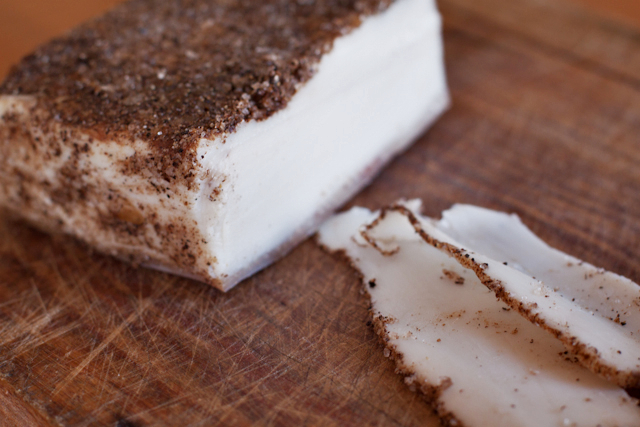
I love what Michael Ruhlman says about lardo in his latest charcuterie book, Salumi, an ode to the art of Italian cured meats: “Lardo is about richness, and the creamy texture of fat and succulence, and all that is good.”
The biggest mistake non-Italian speakers make with this absolutely delicious regional delicacy is that they translate it to “lard”, which, it must be strongly pointed out, it is not. What we call “lard” in English is known as strutto in Italian, which is used commonly for conserving, pastry making or frying. Lardo, however, is cured pig’s back fat, a unique type of salumi. You could think of it a bit like just the fatty part of a beautiful slice of prosciutto – but oh so much more.
Undoubtedly the most wonderful lardo (and the reason for talking about this exquisite food) is the famous Lardo di Colonnata, made using an ancient technique to preserve not just meat but the fat in the village of Colonnata, part of the greater town of Carrara in the north-western corner of Tuscany, near the Ligurian border. Sliced in super thin, practically transparent slices that melt on your tongue, it can simply enjoyed like this as part of an antipasto, or on slices of hot grilled bread for crostini.

The town of Carrara is, of course, famous for its world class white marble, where even the likes of Michelangelo sourced the finest materials to carve his sculptures. It’s a beautiful thing that this prized and prestigious marble is also key to this other art form: making lardo di Colonnata.
The fresh pig’s back fat is first trimmed of any meat hanging on to it until it is just a perfect white slab of fat. It is then layered with salt, pepper, fresh rosemary and sage and a heady mix of sweet, aromatic spices such as nutmeg, cinnamon, coriander and cloves. These layers fit snugly in specially-carved marble troughs known as conche and left to cure for six months. No need for preservatives or refrigeration (this is strictly done in the autumn and winter months) as the naturally porous marble and the caves in which they are kept have their own microclimate perfect for curing lardo.
The resulting lardo is a fragrant, silky block of sweet, piggy flavour, perfectly creamy white with a crust of spices and coarse salt. Something about the magic that happens in those marble vats makes this an extremely unique product, with an incredible texture and flavour that will have you instantly hooked.
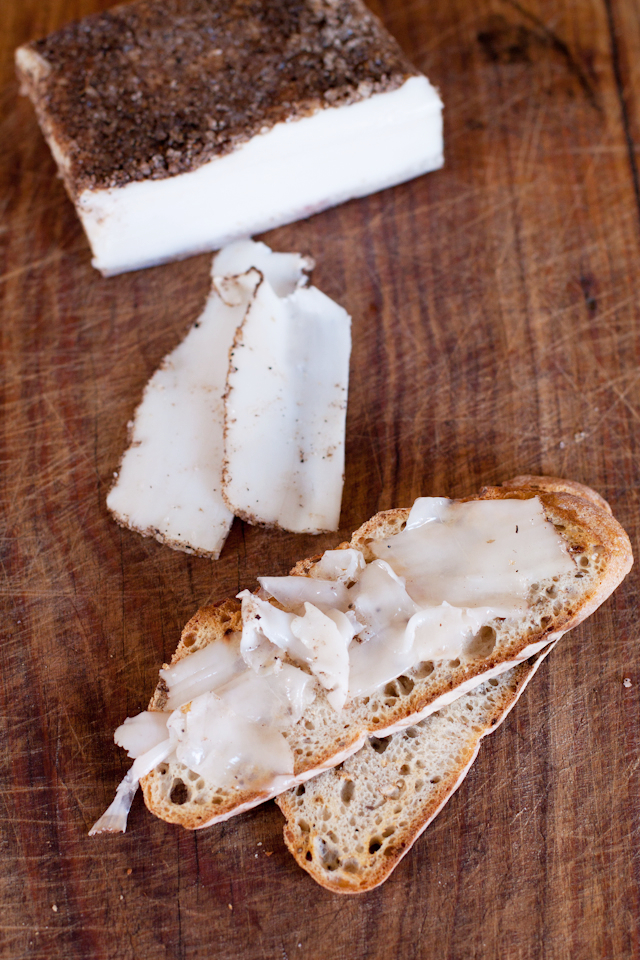
Something this delicious does not need much messing with; as noted above, simply sliced as part of a salumi board or laid out over some hot grilled bread for a literally melt-in-your-mouth antipasto is perfect. But it goes down a treat with some other simple accompaniments as well. In the nearby Cinque Terre town of Monterosso, which is famous for its salted anchovies, I once tried an unforgettable bruschetta-like dish of crostini with chopped Monterosso anchovies, diced fresh tomato and thin, silky layers of lardo di Colonnata, the perfect mixture of the bursting flavours of two neighbouring regions and their age-old traditions.
For a further tempting look at salumi, check out the discussion with the other Italian Table Talk bloggers. Giulia from Juls’ Kitchen does a classic Tuscan delicacy, buristo, with eggs. Valeria from My Love Life Food has a flavour-packed recipe for guanciale spaghetti and Jasmine from Labna challenges the salumi theme with a kosher amatriciana recipe. Keep up with the conversation by following our monthly blog posts or the twitter hashtag #ITableTalk. Coming up next month, we talk Italian breakfasts.


Comments
I’d love to taste this wonderful Italian speciality! I bet it tastes insanely good and has a delightful texture.
Cheers,
Rosa
This is my favorite Italian Table talk- salumi! Here in Colorado a few of the farmers have begun raising some heritage breed pigs (mulefoot being one) and lardo is becoming increasingly common on our restaurant menus. I enjoyed reading more about it here, especially the differences between lardo and lard, which is an easy misconception for those of us who are not Italian. Great post!
Oh that is interesting and great to know it’s becoming popular, especially in what sounds like an artisan effort!
Gosh that looks gorgeous. The fatty bit of salami is always one of my favourite bits so layered on bread this would be absolute heaven!
It’s definitely the tasty bit that shouldn’t be picked off! 😉
Lardo is the king of salumi, my absolute absolute favourite! We had warm crostini with lardo and chopped scallops on Christmas Eve, made by my in-laws. They were special, and wouldn’t mind trying the anchovy version you talk about too. Great post as always xx
Oh wow. Yum. I’ve also had some delicious buffalo mozzarella balls wrapped and baked in lardo at Pitti Gola wine bar that you would love – wonder if they still have them on the menu? x
Che dire… buonissimo… con miele e noci ancor di più!
Non ho mai assaggiato lardo con miele e noci, ma ci proverò! Deve essere buonissimo!
Lardo is the last salume I discovered, I was already a grown up woman (eheh) when I first tried the melting slice of lardo on a crunchy and warm slice of bread. It was love at first bite, since then I like to treat my friends once in a while with lardo. I love to add a few slices over simple pasta and serve it while still translucent and melting, it is so rich!
I can’t believe it, the last?! I understand the love at first bite feeling, that’s really how it works with lardo, isn’t it? 😉
My favourite way to use lardo is on a white pizza with potato, pecorino and rosemary – so yummy! Can you get it in Melbourne? Great post!
Delicious. Haven’t found it here yet, but this lovely one in the photos was brought over by some wonderfully thoughtful friends!
Grazie Emiko,
from you I learned the correct way to name and describe lardo di Colonnata to my guests.
I’m a professional tourist guide in Carrara, sometimes I find problems to convince my guests to come tasting lardo di Colonnata.
After the tour of the marble quarries, everything is easier, because only after knowing the quarrymen’s way of life is possible to understand the Lardo di Colonnata.
Arrivederci
Umberto
Prego, Umberto! It’s one of the most common food-translation mistakes – and what a pity since there is a huge difference between strutto and lardo!! Your unwilling guests don’t know what they’re missing!
Hey Emiko
This reminds me of the Polish delicacy, smalec -delicious pork dripping spread onto sliced sourdough bread served with whole fresh gherkins and downed with warm mulled beer during the bleak cold winter times..yum!
Anyway, the reason for the late post is because I searched for Cinque Terre and this article, amongst several, interested me most…I’m actually planning a trip for 10 days in September and I’d be fascinated to know if you have any cheeky recommendations of where to eat and drink! I’ll be setting off from Levanto and will walk/eat my way through the 5 ‘lands’ ending up at La Spezia before flying home from Pisa. Grateful for any nice ideas 🙂
Avid fan of your blog as ever.
Nicolas Santopaolo
Thanks Nicolas, I do have a few recommendations for the Cinque Terre! The place I mention here in this post in Monterosso is Enoteca Internazionale – a great, informal wine shop/bar that do extremely tasty snacks, platters, etc and have a great selection of local wines that you’ll have trouble finding anywhere else. In Corniglia, I like Osteria da Mananan, the food is very typical, classic Ligurian food and spot on. I also quite like a drink or a coffee perched at A Pie’ de Ma’ in Riomaggiore – it’s right at the start of the Via del Amore, but easy to miss if you’re not looking. It’s just a regular cafe but it literally feels like you’re sitting right on the cliff over the top of the sea and is fantastic on a nice day. Hope you enjoy your time there, it’s a wonderful part of the world!
Hi Emiko
Thanks so much for these recommendations. I fly to Genova on 30 Sep and will certainly pay these nice places a visit…
Nicolas
You’re welcome! Buon viaggio!
“This reminds me of the Polish delicacy, smalec -delicious pork dripping spread onto sliced sourdough bread served with whole fresh gherkins and downed with warm mulled beer during the bleak cold winter times..yum!”
While smalec is delicious, the Poles actually have something much more similar to lardo– called słonina– which basically *is* lardo, just with a different flavoring, usually just salt and paprika. It’s fantastic, and of course it’s used with a much heavier hand in Polish cuisine– think fried with potatoes or bacon and eggs instead of a delicate antipasti plate.
The crispy cracklings that are left behind when you fry it–90% of it renders, of course– are also incredibly delicious, and either eaten with the meal or cut into pieces and stirred as crispy bits into smalec/lard.
Oh how wonderful! This really sounds delicious.
Hi Emiko,
I have been curing prosciutto, sopressata, and a few other items for the past few years. I just returned from a 50 day trip to Italy and had the pleasure of trying many other cured delicacies in Italy, and now have the desire to try my hand at curing Lardo this winter….my dilemma is that i cannot find a one piece marble vat!!!! i live in Canada and work in the US, but have not been able to locate one in either country, nor have i found a place in Italy that ships….any suggestions or resources??? Thanks for the help. Regards, Luciano
Hi, I lived in the outskirt of Milano and that is where I learned of Lardo di Colonnata. I live know in Pennsylvania, about 1 hr. of Philadelphia.
My question is where can I find this exquisite product in this area ? any info would be appreciated.
One more thing: My favorite way to eat ” The Lardo ” is on a slice of good warn bread and a drizzle of truffle oil. Simple taste buds paradise !!
That is a good question — I’m not sure about Pennsylvania or Philadelphia but I would try any very good Italian delicatessen and they might have some insight if they don’t stock it themselves. Sounds like a very good way to eat lardo!
Lardo is now available in Noosa! The newly opened “Eumundi Meats” next to Belmondo’s on Rene St.
Love Susan’s addition of truffle oil……”My favorite way to eat ” The Lardo ” is on a slice of good warn bread and a drizzle of truffle oil. Simple taste buds paradise !!”…will try it!
What would be the best possible lardo – wine pairing?